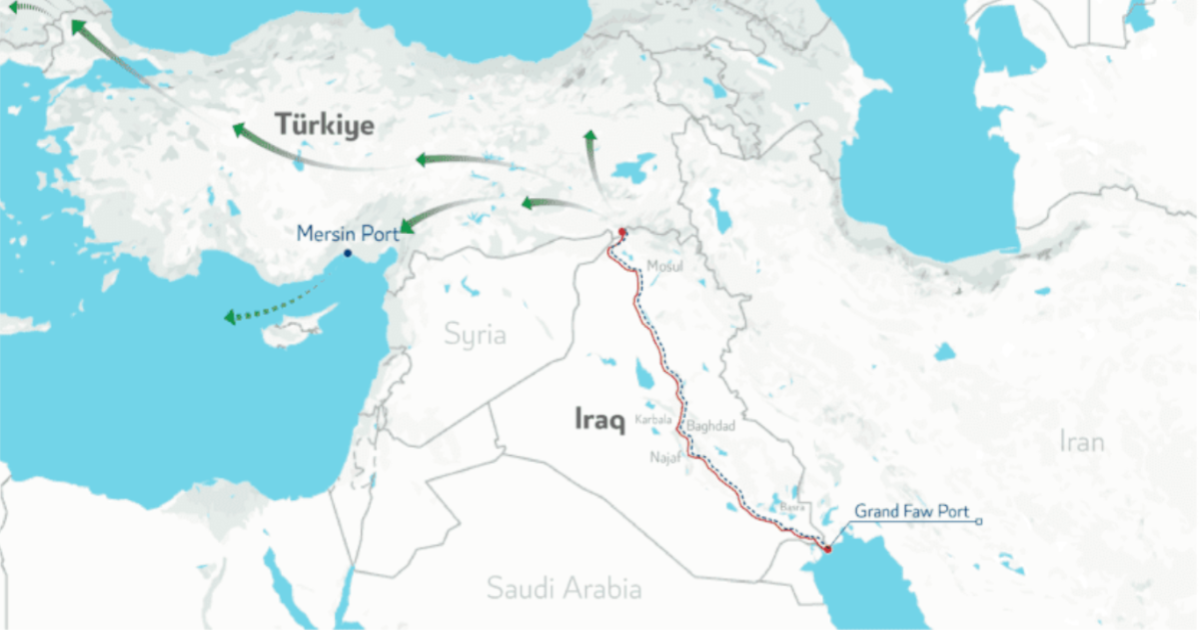
Iraq is aiming to position itself as a vital gateway between Asia and Europe by advancing its ambitious Development Road Project. Despite its generic name, the scale of the project is extraordinary. Stretching over 1,200 kilometers (about 750 miles), the corridor will integrate railways, highways, ports, and cities, significantly cutting travel times between the two continents.
First unveiled in 2023, the “Iraqi Silk Road” has drawn interest as an alternative to the Suez Canal for trade between Asia and Europe. In April 2024, Iraq, Turkey, Qatar, and the UAE signed a quadrilateral memorandum of understanding to cooperate on the project.
Iraq’s Ministry of Transport estimates the cost at around $17 billion. Funding is expected from Gulf partners such as Qatar and the UAE, with additional international investment targeted during the next phase. The Ministry reports that 60% of the project’s strategic designs and maps are complete, with the first phase of construction expected to begin before the end of 2025. Completion will be phased, with milestones set for 2028, 2033, and 2050.
At the heart of the project is a high-speed rail network designed to reach speeds of up to 300 km/h. Spanning the length of the corridor, the rail system will feature about 15 strategically placed stations to enhance regional connectivity. It will serve both freight and passenger traffic, reducing transportation costs and increasing efficiency across Iraq and neighboring regions.
Iraq has also activated the United Nations’ TIR customs transit system, which harmonizes customs procedures and allows freight traveling along the Development Road to cross borders with minimal delays.
The Grand Faw Port, located at the southern terminus of the corridor, is set to become the largest port in the Middle East. Once fully developed, it will feature up to 100 berths and a 14.5-kilometer breakwater—the longest in the world.
Beyond transportation, the Development Road is positioned as a strategy for economic diversification, reducing Iraq’s reliance on oil by leveraging its geographic location. The corridor is projected to generate $4 billion annually and create at least 100,000 jobs.